Lockheed P-38 „Lightning“ F-5G-6-LO
The “Twin-tailed devil”
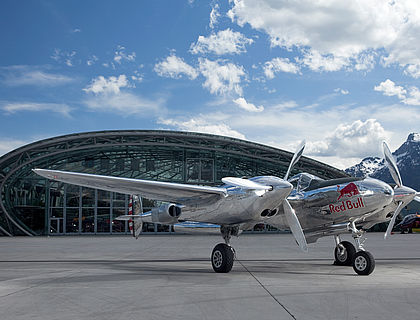
These days, whoever makes Their Way over To Hangar-7 in salzburg to admire the new crown jewel of The Flying Bulls, the lockheed P-38 “lightning” F-5G- 6-LO wiLL mostly go home empty handed. with a bit of luck you can catch a glimpse of it during a refuelling stop bub it mostly comes back to iTs new home only late in the evening.
Can you remember how you felt as a child late on the evening of Christmas Day? When you couldn’t fall asleep and you’d crept over to the presents to carry on playing with them a bit longer? Sigi Angerer, the Chief Pilot of the Flying Bulls must be feeling rather like this right now because he is spending every spare minute with this silver beauty, mostly in the air. Now, the P-38 is not Angerer’s first war bird and he has not just discovered his passion for flying either. The “Lightning” has its own magic which brings to light hidden depths even in hard boiled professionals.
Its previous owner “Lefty” Gardner, a flying legend, a war hero and repeatedly decorated aerobatic pilot even started writing poetry for and about this machine. Others have given up their jobs to concentrate full time on collecting donations for the recovery of a P-38 squadron sunk in the Arctic Ocean off Greenland, and now since the arrival of the P-38, Sigi seems only to have eyes for this one, ignoring all the other beauties of the Flying Bulls. The reason for this can be easily guessed as soon as you get the chance to view the “Lightning” from up close. Even on the outside it is quite something: The tri-fuselage construction looks like a cross between an American road cruiser of the 50s and a space ship straight out of a sci-fi film.
When the Allison 12-cylinder engines are started up you realise why they have earned the name turbo-supercharged engines: ‘The sound of each of the 1,500 hp motors appeals directly to your most basic instincts. Watching the machine at its high speed flying manoeuvres in the sky, with its unique steering structure framing the pilot’s cabin and both of the jet propulsion engine fuselages, even those with a fear of flying are gripped with a fascination for this machine which already caused a great commotion during its first presentation not only because of its design. In order to gain a better weight-performance ratio, the Lockheed engineers broke with the conventions of that time in the late 1930s and fitted the machine with only one cockpit seat instead of the usual two whilst providing it with two engines.
This ensured a longer range and most of all a higher maximum speed: with approx. 660 km/h, it was more than 160 km/h faster than any aeroplane in the US military at that time. Its maximum flying altitude of 6,500 m could be attained in about six minutes which was an amazing breakthrough at the time in the 1940s. And today, that is still tantalizing enough to steal the hearts of even the most hard boiled of professionals.
Factbox
| Name: | P-38 Lightning |
| Nickname: | „Twin-tailed devil“ |
| Manufacturer: | Lockheed |
| First flight: | 27. January 1939 |
| Production period: | 1941 to 1945 |
| Original function: | Interceptor and fighter bomber |
| Special features: | Tri-fuselage construction, manoeuvrability |
| Length: | 11.55 m |
| Wingspan: | 15.88 m |
| Height: | 2.99 m |
| Maximum range: | 3.620 km |
| Engine: | 2x Allison V-1710-27 |
| Maximum speed: | 666 km/h |
Further information
Sigi Angerer's Logbook
P-38 und die Kunst des Fliegens
We actually wanted a P-51 Mustang, but at the moment there are around 170 of them. It was never my dream to have a Lightning – because that was unachievable – but then I knew of one that had made an emergency landing. How matters progressed afterwards has become widely known. But time now for a short review: Only a handful of pilots on this planet can fly P-38s – that’s not because the other pilots have not got the necessary skill – it’s because they do not have a P-38.
At the moment there are four Lightnings capable of flying: there is only one in Europe and that is ours! The real art is therefore in finding one, buying it and restoring it. On a scale of difficulty flying a P-38 is much lower down and that’s where I come in. Weather permitting I practice several times a week; the entire construction is from the late 1930s with a few built in shortcomings: the brakes for example – you steer the plane on the ground using them – they are so stiff that I always wear my mountain climbing boots: that’s also because I don’t have any soccer boots either. The propeller and the oil cooler flaps are electrically operated, the water cooler flaps, the landing flaps, ailerons and undercarriage are hydraulically operated and the steering is by means of mechanical linkages.
Then there is the gas pedal, the mixture control unit, the radio apparatus, navigation equipment, various diverse additional pumps and fortunately enough there is also an autopilot. At times you need three or four hands, but the airplane is a single seater. The view outside is not particularly good for a fighter plane, but in any case you don’t have that much time to admire the scenery: a change in height for example requires up to 16 movements of the hands.
But it is only when you are in the air that you are really sitting in the Cadillac of airplanes: comfortable, a scarcely audible sound from the engine – a wonderful noise produced by 2x12 cylinders – almost 3,000 HP and no one there to say: ‘Can I fly?’. Thanks to the design of the undercarriage the landing is really simple, but then you still have to brake and steer… All in all it is a wonderful experience and I am permitted to be there – my heartfelt thanks to our true artists.
Sigi Angerer
Head pilot of The Flying Bulls
Related Articles
- all
- Logbooks
- Pilots
From the Hangar-7 Journal:
Sigi Angerer's logbook
The “Twin-tailed devil” /en/the-flying-bulls/cessna-c-337-push-pull/
From the Hangar-7 Journal:
Sigi Angerer's logbook
Air Force Number One /en/the-flying-bulls/north-american-t-28b-trojan/
From the Hangar-7 Journal:
Sigi Angerer's logbook
The “Twin-tailed devil” /en/the-flying-bulls/lockheed-p-38-lightning-f-5g-6-lo/
From the Hangar-7 Journal:
Hans Huemer's logbook
The winged messenger /en/the-flying-bulls/pilatus-porter-pc-6/
From the Hangar-7 Journal:
Sigi ‘Blacky’ Schwarz’s Logbook
The artist /en/the-flying-bulls/mbb-bo105-cb/
From the Hangar-7 Journal:
Sigi Schwarz’s Logbuch
Welcome to the club! /en/the-flying-bulls/eurocopter-ec135/
From the Hangar-7 Journal:
Sigi Angerer's logbook
From the Hangar-7 Journal:
Sigi Angerer's logbook
The Time Machine /en/the-flying-bulls/boeing-pt-17-stearman/
From the Hangar-7 Journal:
Sigi Angerer's logbook
Pirate of the Skies /en/the-flying-bulls/chance-vought-f4u-4-corsair/
From the Hangar-7 Journal:
Sigi Angerer's logbook
The Cadillac of airplanes /en/the-flying-bulls/b-25j-mitchell/
Siegfried "Blacky" Schwarz
The Flying Bulls' chief helicopter pilot /en/the-flying-bulls/piloten/siegfried-blacky-schwarz/
Sigi Angerer
Legendary pilot and father of the "Flying Bulls" /en/the-flying-bulls/piloten/sigi-angerer/